
Different Types Of Dance Forms In India
Key Takeaways
Before we dive into India’s mesmerising world of dance, here’s what you’ll discover.
- India has eight classical dances, which are linked to different parts of the country and culture.
- There is a large diversity of folk dances that accompany the celebration of local festivals, as well as supporting agriculture and the bonds of the community.
- Dance uses the poetic, visual art form of mudras, which are intricate hand gestures to tell a story.
- The different dance styles in India are a living heritage that intertwine spirituality, storytelling, and culture.
- Modern versions of dances incorporate the new and the traditional.
Introduction to Dance Forms In India
India is a country which is rich in culture, and dance is one of the most elegant art forms of the country, which the world should appreciate. The dance forms in India are a collection of excitement, community festivals, culture, and even different forms of spirituality that are all unique in their own form. The string of culture is like a rhythm doused in holy water. Dance is alive from the courtyards of the temples in Tamil Nadu to the farms in Punjab in the harvest season. The world has stopped colonising, modernizing, and invading the Bharatanatyam dancer, whose foot is in perfect synchrony with the Garba, which is twirled by villagers.
Why India Has the Most Diverse Dance Traditions in the World
India, unlike any country in the world, has a captivating array of dances, and mastering each of them can take a lifetime and beyond. But how exactly did this exceptional diversity come to be?
India’s Geographic Diversity.
Because of India’s geographic diversity, each region developed dance styles that were influenced by the region’s environment, costumes, and lifestyle. Kerala’s gentle coastal environment, for example, inspired the floating movements of Mohiniyattam. Ghoomar, on the other hand, matches the energy and vigour required to survive the harsh desert conditions of Rajasthan.
The thousands of years of the merging of religion and spirituality with the arts have led to the development of complex vocabularies in dance. Most classical dance forms in India can be traced back to the traditions of Hindu temples, where the Devadasis, or dancers, performed in a ritualistic manner to animated scriptures. The delicate footwork of Kathak, for example, was influenced by the Islamic courts and their intricate dancing. India’s dance forms and styles developed through history in such a way that they will always be complex in nature. Each of India’s 22 official languages helped weave distinct narratives, which were created and retold in varied ways. During the reign of the Chola dynasty, for example, Bharatanatyam was elevated, and during the reign of the Mughal dynasty, Kathak was refined, leading to the diverse forms of dance that exist in India today.
Quick Faq’s
1) How many forms of classical dance are there in India?
The Ministry of Culture in India has classified eight dance forms as classical: Bharatanatyam, Kathak, Kuchipudi, Odissi, Kathakali, Manipuri, Mohiniyattam, and Sattriya.
2) What are some of the major cultural factors that characterise and contribute to the diversity of dance traditions in India?
The existence of many religions gave rise to different forms of devotional dance. The geo-cultural region of a people determined the mannerisms of the dance. Differences in language influenced the manner of narration, which has resulted in an evolution of the forms of dance we have today.
3) What are the impacts of regional differences on the styles of Indian dance?
Each state has its own unique traditions that are still celebrated today with great pride. The region’s climate helps to nuance the styles of the local dances, which also appear in costumes. Regional dance is also deeply rooted in the people’s identity and serves as a banner.
4) In which ways have religion and spirituality affected the Indian heritage in dance?
The initial stages of dance had to do with worship rather than performing. Devadasi dancers, as a form of reverence, offered technical skill and artistry to the deities. Hindu mythology, with its abundance of stories, serves as the foundation. The spirituality behind Indian dances gives them uniqueness.
5) What is the value of the element of storytelling in Indian dance traditions?
In the past, when the art of writing was not that common, people still needed a way to tell stories. Dance assumed the unique role of motion and history. Every single dance of India is woven with a rich narration.
6) Which states have their own distinct dance forms in India?
The prominent and highly celebrated dances in India include Bharatanatyam (Which is from Tamil Nadu), Kathakali (From Kerala), Kathak (From Uttar Pradesh), Odissi (From Odisha), Bhangra (From Punjab), Garba (From Gujarat), and Ghoomar (From Rajasthan).
What are The Major Types of Dances In India
India is home to a myriad of different dance types, and when analyzed, the dance types of India fall under two superb divisions.
Classical Dance
Bharatanatyam, Kathak, Kathakali, Kuchipudi, Odissi, Manipuri, Mohiniyattam, and Sattriya are her eight classical dances.
Folk Dance
Folk dances originate from societies and communities. They depict the mundane and the routine, the seasons and the changing of seasons, and celebratory remembrances of the year, religion, and life. Although the dances are of a simpler style, they show intricate physical movements and patterns, as rhythm and routine are essential.
Quick FAQ’s
- Which forms of Indian dance have UNESCO recognition as a part of the cultural heritage of India?
The Chhau dance, the Kalbelia folk songs and dances of Rajasthan, and the Sankirtana of Manipur are all listed by UNESCO. - In what ways do folk dances in India relate to agriculture and rural life?
Most folk dances commemorate important events in farming. In Punjab, Bhangra is performed to celebrate the harvesting of the wheat crop. In Gujarat, Garba is performed in honor of the fertility goddess during the season of sowing. - In what ways have traditional Indian dance forms been changed to suit modern times?
Bollywood dance combines classical styles with Western as well. Contemporary designers of dance do fusions. Digital media have promoted Indian classical dance and made it accessible on an international level. The different dance forms in India continue to adapt while preserving their traditional essence. - What makes Bharatanatyam, Kathak and Odissi the major dance forms of India?
The sheer number of people who practice these three forms, as well as the amount of documentation, is what makes them dominant. Huge institutional ownership resulted from the Bharatanatyam revival in the 20th century. - How have the major dance traditions of India changed during the course of history?
The beginnings of these traditions in temples, along with court sponsorship, were changed by the colonial period, which tried to erase them. The colonial period’s attempt to erase traditions was countered by the Independence movement, which embraced dance as a part of national heritage. - What is the reason Indian dance forms are viewed as a part of the cultural identity and expression of a people?
These dances convey the values of the community, religion, and their history. There is a form of movement that the body does that the mouth is incapable of.
List of Different Classical Dance Types In India
Let me take you through each classical treasure. These different dance forms in India represent thousands of years of refinement. The following dance names and types showcase the eight classical forms recognized by the Ministry of Culture:
1. Bharatanatyam
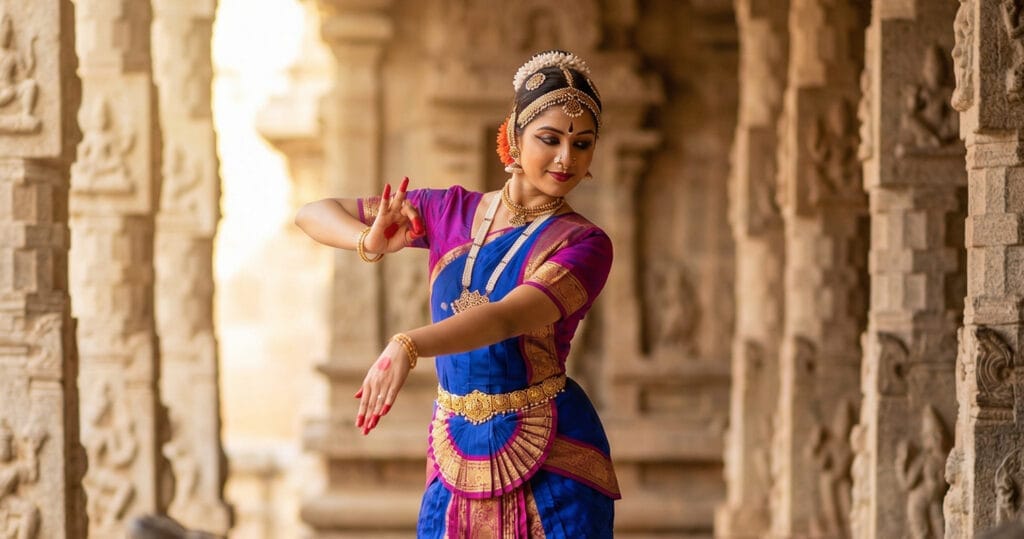
A classical dance form originating from the state of Tamil Nadu.
Performance is primarily a solo activity as the dancer is accompanied by chest and shoulder jewellery, ankle bells, and a silk saree with a temple-style fan. Born and first performed in Tamil temples by the devadasi, it was celebrated again by Rukmini Devi Arundale in the 1930s.
2. Kathak
A classical dance form from Uttar Pradesh.
It can be performed as a solo or in a pair. The dancer is adorned with more than 150 bells and wears a flowing costume. The word “kathak” means a “storyteller”, and it was the Mughal courts that added the Persian forms to the Hindu concepts.
3. Kathakali
A form of classical dance in the state of Kerala.
Groups perform it as a theatrical form of drama. Dancers use complex facial expressions, elaborate top pieces, and makeup. It takes epics like the Mahabharata or the Ramayana and turns them into a theatrical form that lasts all night.
4. Kuchipudi
A dance form from the state of Andhra Pradesh.
It can be performed by individuals or in groups. The dancer wears a silk saree, dances with a plate, and does dramatic acting. It is believed to have started in a village in Andhra and is the best combination of dance and dramatic acting in the form of Sanskrit dialogue.
5. Odissi
A dance form originating from the state of Odisha.
It is danced mostly by individuals. The dancer wears a classical saree and is adorned with silver jewelry. The dance form was first discovered in an Odisha temple. The key temple poses of the dancer are called tribhanga and are known to be the best poses a dancer can bring to a sculpture.
6. Manipuri
Classical Dance of Manipur
Performance: Group presentation dance
Costume/Props: Barrel-shaped costume and other textiles
Cultural Significance: Vaishnavite devotion. Ras Leela is a part.
7. Mohiniyattam
Classical Dance of Kerala
Performance: Solo dance
Costume/Props: saree in white or off white with a gold border and other accessories
Cultural Significance: Divine act of Mohini. Soft and graceful.
8. Sattriya
Classical Dance of Assam
Performance: Solo dance and group dance
Costume/Props: Assamese costume and small cymbals
Cultural Significance: Saint Sankardeva in the 15 century. A living monastery tradition.
Different Technicalities of Classical Dance
In India, each dance form has its own technical vocabulary that has to be understood to facilitate comprehension:
Nritta
Rhythmic movements without meaning that are performed with mastery of technique.
Nritya
Movement with expressive articulations that encompasses emotion.
Natya
A complete form that includes a dramatic presentation with speech.
Abhinaya
There are four types: Angika (body), Vachika (speech), Aharya (costume), and Sattvika (emotion).
Tala
Sophisticated structures of beats that organise the music.
Rasa
There are nine of them: love, humor, pathos, anger, heroism, terror, disgust, wonder, and peace.
Mudras
Set patterns of the fingers that have specific meanings.
Adavus
Basic sequences of movements of Bharatanatyam.
Bhava
The emotion that is felt and performed.
Karanas
The basic 108 sequences from the Natya Shastra.
Charis
Patterns of stylized walking.
Mandala
Shapes made by the body.
Quick FAQs
- Which Indian state is associated with each classical dance form?
Bharatanatyam- Tamil Nadu, Kathak- Uttar Pradesh, Kathakali and Mohiniyattam- Kerala, Kuchipudi- Andhra Pradesh, Odissi- Odisha, Manipuri- Manipur, Sattriya- Assam. - How did classical dance evolve in India over the centuries?
Temple rituals were sponsored by royalty. British colonizers wanted to remove the spirit of dance from our culture. The movement for independence restored dance as a national treasure. - What are the spiritual or religious roots of Indian classical dance?
Each form was created for the purpose of worship. The dancer was considered a bridge of communication between the deities and the mortals. Hindu legends served as the source of stories. - What are the characteristics that set Bharatanatyam apart from the genres of Kathak and Kuchipudi?
In Bharatanatyam, the sitting posture is rigid and geometric, and the legs are bent downward. In Kathak, the dancer focuses on the foot, and the body posture is upright, often moving the body in spins. Kuchipudi has unique devotional dancing stamina and intensity, as well as features, such as dancing on plates made of brass. - What is the reason for Kathakali’s reputation for highly emotional body movements, along with the intricate, worn clothing?
This developed as a visual art for all-night theatre performances. Dancers and actors use colours for the face, along with elaborate makeup. Dancers master individual facial movements that show awe-inspiring and even minute emotions, as well as other emotions such as terror. - In what way is the Manipuri dancing style unlike the other classical dances of India?
The most important quality of Manipuri is the smooth movement, which is a gentle movement. The dancers do not strike their feet harder, but rather strike with grace for smooth and constant movement like a waterfall. - What is the relevance of Sattriya and Mohiniyattam in the culture of India?
In India, Sattriya forms a living, uninterrupted and monastic tradition. Mohiniyattam retains the purest forms of lasya. Both were on the brink of extinction, and the attempt to revive them shows immense cultural strength. - In a classical dance, what are the meanings of the terms Nritta, Nritya, and Natya?
Pure movement that is not tangible and can be seen in a dance is classified as Nritta. Emotional and expressive narration is added through dance in the stage of Nritya. In Natya, there is a complete integration of a dramatic performance, in which the performer as a character is fully enacted. - In what way do your abhinaya interpretations enhance an entire performance?
Abhinaya artistry shifts rigid motions in dance to emotions. The four elements of body language, words and music, costume, and feeling contribute towards emotional performance. - In what ways do rhythm and tala influence the formation of the movements of a classical dance?
Tala gives the structural framework of the performance in a mathematical sense. Every action has to equate to a particular action in a rhythm cycle. - What are adavus in Bharatanatyam? Why are they a celebrated phenomenon?
Every Bharatanatyam dancer and performer knows that adavus are the foundational steps that all movements derive from. Even at a novice level, these are the basics that choreographers expect dancers to master before tackling any intricate sequences. - How do classical dancers achieve a harmonious balance between elegance and accuracy?
In the classical dance technique, expression and emotional performance are prioritized. This is the reason that dancers are required to undergo intensive training and practice until actions are habitual. Personal attention is given through the guru-shishya system.
Different Folk Dances of India by State
The list of Indian states and their corresponding folk dances captures the creativity of the nation in vivid and colourful dance forms. Exploring various dance forms in India reveals the rich tapestry of regional expressions. This comprehensive types of dance styles list showcases the diversity across different states:
List Of States and Their Folk Dances
Here’s the State Folk Dances information in table format:
| State | Folk Dances |
| Andhra Pradesh | Kuchipudi (folk), Lambadi, Dhimsa, Kolattam |
| Assam | Bihu, Bichhua, Bagurumba, Jhumur |
| Bihar | Jata-Jatin, Bidesia, Jhijhian |
| Chhattisgarh | Panthi, Raut Nacha, Karma |
| Goa | Fugdi, Dhalo, Dekhni, Kunbi |
| Gujarat | Garba, Dandiya Raas, Bhavai |
| Haryana | Jhumar, Phag, Dhamal |
| Karnataka | Yakshagana, Dollu Kunitha |
| Kerala | Theyyam, Thiruvathirakali |
| Madhya Pradesh | Jawara, Tertali, Phulpati |
| Maharashtra | Lavani, Koli, Tamasha |
| Manipur | Pung Cholom, Lai Haraoba |
| Odisha | Chhau, Gotipua, Ghumura |
| Punjab | Bhangra, Giddha, Sammi |
| Rajasthan | Ghoomar, Kalbeliya, Kachhi Ghodi |
| Tamil Nadu | Kavadi, Kummi, Kolattam |
| Uttar Pradesh | Nautanki, Raslila, Kajri |
| West Bengal | Chhau, Baul, Jatra |
Dances of folk culture express gratitude for rainfall, the harvest, and the joyful experience of celebration, and pay homage to gods. Folk dances are more inclusive and approachable than their more rigidly structured classical forms. Understanding different types of dances in India helps appreciate the cultural diversity across regions.
Quick FAQs
- In what ways do Garba and Dandiya Raas best illustrate folk dance from the state of Gujarat?
All forms of dance around the world are featured in endless variation and profusion in Gujarat during the Navratri festival. Garba dance is appreciated for the symbolic representation of the circle, which illustrates the eternal cycle of life. Its energy is more than enough to cause people far away to join in the dance. - How do states like Rajasthan and Haryana celebrate folk storytelling through dance?
Rajasthan Kalbeliya is the dance of the Kalbeliya (snake charming) people, which evokes the serpentine stories of their community. Ghoomar is a dance which captures the bravery of Rajputs. From the folk culture of Haryana, the Saang form presents stories from the past using representation. - Which folk dances of India have gained international recognition?
The festivities we engage in today, full of vigour and exuberance, celebrate some of the famous dances of India, some of which have gained global recognition.
Bhangra, with its electric enthusiasm and vigorous attire, overwhelmed the world’s pop culture, and Garba, with its celebration culture, similarly embraced the large Diaspora communities. Kalbelia managed to gain recognition of its own and, along with the others, managed to earn India UNESCO Recognition. When exploring all types of dances in India, one discovers the profound connection between movement and cultural identity. - What costumes and dress styles are typical in the state folk dances of India?
Rajasthan dancers wear beautiful ghagras with multi-embellished mirror work, adding accessibility to the cape. In Punjab, the Bhangra outfit with the graceful turbans, vivacious dhotis, and the splendid piece of an added headband is featured in exuberance, capturing the regional and global essence, coupled with the offer of dynamic movement.
Different Types Of Classical Dance Mudras
The wheels of dance also have their own form of rhythmical art, Classical. Each dance form has its own layers, and for Indian Classical Dance, from the many different forms, the “Mudras” do bloom, blossoming in a magnificent form of which we still yearn to learn about. Every formation with integrated hand gestures has its own beauty and form. Anyone curious about “what are the different types of dance” will find that mudras serve as a universal language across all classical forms.
The foundation for the forms of mudras is crafted in the Natya Shastra. Every dancer has their own style. Every dancer has to learn each mudra groove and systematically memorize the meaning of the formation, signifying the gesture, along with its corresponding name.
The Abhinaya Hasta incorporates different story forms with its own emotions, gestures, and characters that the dancer has to embody. Shudras, who are simple dancers, do not have to worry about their emotions and focus only on the pure stances of the graceful Abhinaya. Less complex forms of the hand, as well as the full body, which comprise Nakra Mukt, and the graceful “clear” hand gestures, are in the Shudra forms.
“Beautiful,” said a Shudra of many forms, many beginnings as they glide across the stage, losing herself in the art of Mudras.
Quick Faqs
- What is the total number of mudras in Bharatanatyam, Kathak, Odissi, and other classical Indian dances?
Classical texts state that foundational vocabulary consists of 28 single-handed and 23 double-handed mudras. Each dance form derives its own meaning from these foundational mudras. - What distinguishes Asamyukta Hasta from Samyukta Hasta in classical dance?
Both terms are used to describe the employment of one hand independently, as Asamyukta Hasta and coordinating both hands together in Samyukta Hasta. - What is the significance of mudras in the storytelling and expression of classical dance?
Mudras elevates a dancer’s role beyond that of a performer. With face and body expressions, mudras creates dances that tell stories beyond the boundaries of language. - In classical dance, is it possible for mudras to embody and convey different emotions (rasas) and different scenes?
Yes, Anjali mudra, under certain conditions, may express reverent prayer or desperate supplication depending on the music and face. - What techniques can performers engage in to ensure that they maintain the intended accuracy and the proper posture when performing mudras?
A reasonable amount of practice is needed. Instructors scrutinize and adjust finger positions to the correct angles. Practicing in front of mirrors is also part of the training. - What forms of exercise or training develop sufficient flexibility and strength of the hands for performing the mudras?
Finger strength is improved by yoga and wrist rotations.
Quick Topics on Dance To Learn More:
The Thematic Regional Variations of Mudras in Different Styles of Classical Indian Dance
The Natya Shastra serves as a foundation, but over the years, every tradition has developed its own distinctive takes to go with it. Bharatanatyam executes a mudra with the sharpest and most geometric precision. Kathak has the most freedom. Odissi has the tribhanga position incorporated. Manipuri is more gentle with the mudras.
Concise Articulated Details:
- Bharatanatyam: Sharp, geometric, rudimentary precision.
- Kathak: flowing, unbroken, moving and changing.
- Odissi: sculptural, ideal, and cohesive.
- Manipuri: easy, reverential, and tender.
- Kathakali: Theatrical, over-the-top, and rooted in show.
Mudras Beyond Natya Shastra
Mudras, beyond the frame of dance and performing art, exist in the spiritual geography of India. Yoga practices incorporate hand postures in therapeautic ways, while some Buddhist statues illustrate the teaching mudras.
Therapeutic and Yogic Significance of Mudras
Very recent studies are beginning to focus on the therapeutic possibilities of mudras. Each of the fingers connects to a particular meridian of energy. Participants claim that they are more focused and stressed less. For those learning about different dance types, understanding the meditative aspects of mudras adds depth to practice.
Symbolism and Spiritual Meaning of Hand Gestures
Every mudra holds a specific, established set of symbolisms. Anjali represents harmony of duality. Abhaya provides some protective energy. The fingers and elements create certain philosophical relations.
The symbolic structures are as follows:
- Geometric forms in the arrangement of the fingers,
- Religious and mythical associations,
- Representations of nature and other forms,
- Shapes of ideas of a high level of abstraction.
Mudras in Temple Sculpture and Iconography
Ancient temples with mudras caught in time have the dance culture of that time preserved. The Nataraja in Chidambaram exhibits the postures of a cosmic dance. The panels in Konark helped reconstruct Odissi. Studying all dance forms of India A through temple iconography reveals ancient choreographic traditions.
Digital Preservation and AI Analysis of Mudras
Documentation of mudras advances with technology. Master dancers’ movements are captured with motion capture technologies. AI systems analyze movements and give feedback in real time. Training in virtual environments is performed in virtual reality. The dancing styles list continues to expand as technology preserves and promotes traditional forms.
India’s dance traditions continue to evolve, all the while adhering to the roots of the ancient art. Whether one wants to learn Bharatanatyam dance or a Kathak dance course at institutions such as Geetanjali Harmonica Institute of Music (GHIM) or even enrol in dance and several other courses, including a Carnatic music course, they will realise that India’s dance heritage is indeed fascinating. These dance forms, as dynamic practices, integrate the past, the present, and the future in the art of movement. Exploring the different types of dances in India and the dance styles in India offers a window into the soul of this ancient civilization, where every gesture tells a story and every movement carries meaning.